History What it was
Only wealthy households could pay for water piped straight into their homes. Everyone else collected water from public fountains. In Roman towns these were usually simple rectangular basins made of stone slabs, placed at street corners with a spout that poured water in continuously.
In Pompeii, archaeologists have found street fountains spread across the town so that most homes were only a short walk from one. Some basins still have smooth, worn spots on the rim where people leaned to fill their jars.
History How it worked
Roman fountains had no taps. Water from the aqueduct ran into the basin day and night, and the overflow spilled into the street. This running water helped wash the streets and drains clean. Public fountains were given first claim on the water supply, ahead of baths and private homes, so ordinary people would not go without.
Many spouts were carved with faces of gods, animals or masks, which made each fountain a small landmark people could use to give directions.
History Life at the fountain
Fetching water was a daily job, often done by children, servants or enslaved workers. Carrying heavy jars meant the fountain was a meeting place where neighbors talked and news spread. In the city of Rome, the water commissioner Frontinus wrote about the importance of keeping the public basins supplied.
Art In this artwork
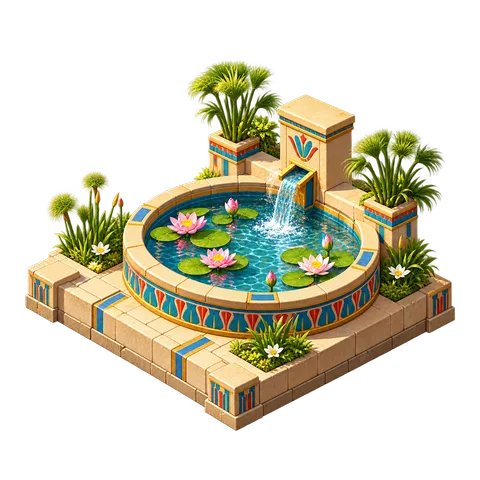
This fountain is grander than the plain street basins found in Pompeii. Its design is the artist's own.
Look closer
- Find where the water pours in and where it overflows.
- Look at the carved stone around the spout.
Think about it
- Who would use a public fountain, and how often?
- How would daily life change if your home had no running water?
- Why did Romans let the water run all the time instead of turning it off?
Key words
- Lacus
- Latin for a public water basin.
- Overflow
- Extra water that spills over the edge.
- Spout
- A short pipe or opening that water pours out of.
Use it in class
- Build a model Roman aqueduct: a hands-on STEM activity (Project, grades 4-8)
- What was daily life like in ancient Rome? (Explainer, grades 5-12)
- How did Roman aqueducts work? (Explainer, grades 4-12)
Sources
The history on this page is a short summary based on these sources:
- Frontinus, The Aqueducts of Rome (about AD 97)
- Encyclopaedia Britannica, "Aqueduct"
- UNESCO World Heritage Centre, "Archaeological Areas of Pompei, Herculaneum and Torre Annunziata"