History What it was
An aqueduct is a man-made channel for moving water. The Romans did not invent the idea, but they built aqueducts on a scale no one had before. The first one to supply the city of Rome, the Aqua Appia, was built in 312 BC. Over the following centuries more were added, and by the 3rd century AD the city was served by eleven major aqueducts.
Most people picture tall stone arches, but arches were only a small part of the story. Most of a Roman aqueduct ran underground in a covered channel, which kept the water clean, cool and safe from attack.
History How it worked
Water flows downhill, so engineers surveyed the land carefully and built the channel with a very slight, steady slope all the way from the source to the city. If the slope was too steep the water would rush and wear away the channel; too gentle and it would stop flowing.
When the route had to cross a valley, builders raised the channel on rows of arches so the slope could stay the same. The arched bridges we see today, such as the Pont du Gard in France, are these valley crossings.
- Water was collected at a spring, river or lake in the hills.
- It ran through a covered channel lined with waterproof mortar, mostly below ground.
- Settling tanks let mud and sand sink to the bottom.
- In the city, the water reached a distribution building (a castellum) that split it into pipes.
- Lead or clay pipes carried it to public fountains, baths and some private houses.
History Who looked after it
Aqueducts needed constant care: cleaning out mineral deposits, fixing leaks and stopping people from secretly tapping the pipes. Around AD 97, a senator named Frontinus was put in charge of Rome's water supply. He wrote a detailed book describing each aqueduct, how much water it carried and the problems of theft and poor repair. It is one of the best sources we have on how the system was run.
History Places you can still see
The Pont du Gard in southern France carried water to the Roman city of Nîmes and is almost 50 meters high, with three levels of arches. The aqueduct of Segovia in Spain still crosses the middle of the town, built from granite blocks fitted together without mortar. Near Rome, the Park of the Aqueducts preserves long stretches of arches marching across the countryside.
Art In this artwork
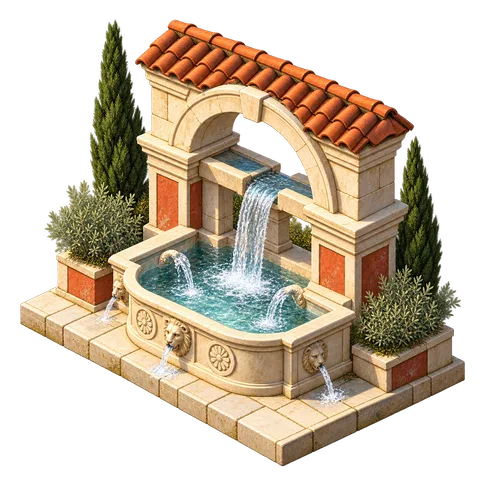
This short arched section is a simplified illustration. Real aqueduct bridges were much longer, and most of the channel was hidden underground.
Look closer
- Find the water channel running along the top of the arches.
- Notice how the arches keep the channel level across the gap.
Think about it
- Why might engineers keep most of the channel underground?
- Where does the water in your home come from, and how does it get there?
- What would happen to a city if its aqueduct were cut off?
Key words
- Gradient
- How steeply something slopes.
- Castellum
- A building where incoming water was divided into pipes.
- Arcade
- A row of arches.
Use it in class
- Build a model Roman aqueduct: a hands-on STEM activity (Project, grades 4-8)
- Roman engineering: arches, concrete, roads and domes (Lesson, grades 6-10)
- How did Roman aqueducts work? (Explainer, grades 4-12)
- How do cities get clean water? (Explainer, grades 4-12)
- Free images for the classroom: how to use and credit them (Guide, grades Teachers, 6-12)
Sources
The history on this page is a short summary based on these sources:
- Encyclopaedia Britannica, "Aqueduct"
- Frontinus, The Aqueducts of Rome (about AD 97)
- Vitruvius, On Architecture (1st century BC), Books 2, 5, 8 and 10
- UNESCO World Heritage Centre, "Pont du Gard (Roman Aqueduct)"
- UNESCO World Heritage Centre, "Old Town of Segovia and its Aqueduct"