History What it was
The circus was Rome's home of chariot racing, the most popular sport in the Roman world. The biggest was the Circus Maximus, in the valley between the Palatine and Aventine hills. It was rebuilt and enlarged many times and held a vast crowd: estimates range from about 150,000 to more than 200,000 people, several times the Colosseum's capacity.
History How a race worked
- Chariots, usually pulled by four horses, lined up in starting gates called carceres.
- When a cloth was dropped, the gates opened at once.
- Drivers raced around a long central barrier called the spina, turning sharply at posts at each end.
- Lap counters shaped like eggs and dolphins showed the crowd how many laps were left.
- A race was usually seven laps.
The tight turns were the most dangerous part. Drivers wrapped the reins around their bodies to steer by leaning, and are said to have carried a knife to cut themselves free if they crashed.
History Teams and fans
Under the empire, racing was organized into four teams, or factions, each with its own color: Red, White, Blue and Green. Fans were fiercely loyal, and rivalries sometimes led to fights. Successful drivers became famous and wealthy, much like sports stars today.
Races cost less to stage than gladiator games, so they could be held more often, and chariot racing continued long after gladiator fights ended.
History Places you can still see
Today the Circus Maximus is a long grassy park in Rome whose shape still shows the track. The Circus of Maxentius, beside the Via Appia outside Rome, is better preserved and shows the starting gates and the central barrier. An Egyptian obelisk that the emperor Augustus placed on the central barrier now stands in Rome's Piazza del Popolo.
Art In this artwork
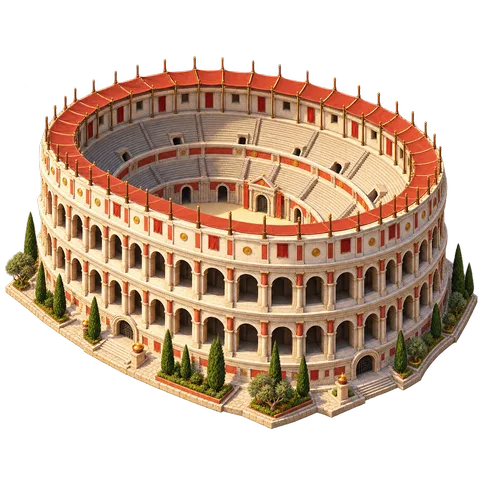
The track shown here is much smaller and shorter than the real Circus Maximus.
Look closer
- Find the central barrier down the middle of the track.
- Look for the starting gates at one end.
Think about it
- Why might a long, narrow shape suit chariot racing?
- Why do you think fans felt so loyal to a team color?
- What makes a sport popular enough to fill a stadium?
Key words
- Spina
- The central barrier the chariots raced around.
- Carceres
- The starting gates.
- Faction
- A racing team.
Sources
The history on this page is a short summary based on these sources:
- Encyclopaedia Britannica, "Circus" and "Chariot racing"
- Encyclopaedia Britannica, "Appian Way"
- UNESCO World Heritage Centre, "Historic Center of Rome"