Part 27 of 35 A crown of thorns
That night, Peter followed at a distance to the high priest's house. Sitting by a fire in the courtyard, he was asked three times if he knew Jesus, and three times he said no. Then the rooster crowed, and Peter remembered Jesus's words, "and he went outside and wept bitterly" (Luke 22:62).
In the morning, Jesus was taken to Pontius Pilate, the Roman governor. "Are You the King of the Jews?" Pilate asked. Jesus answered: "My kingdom is not of this world" (John 18:33–36). Pilate found no crime in him, but the crowd shouted, "Crucify Him!" To please them, Pilate handed Jesus over to be crucified (Mark 15:13–15).
The soldiers dressed him in a purple robe, "twisted together a crown of thorns, and set it on His head," and mocked him: "Hail, King of the Jews!" (Mark 15:17–18).
Bible A crown that lasts
Winners at the ancient games received a crown of leaves. The apostle Paul wrote: "They do it for a crown that is perishable, but we do it for a crown that is imperishable" (1 Corinthians 9:25).
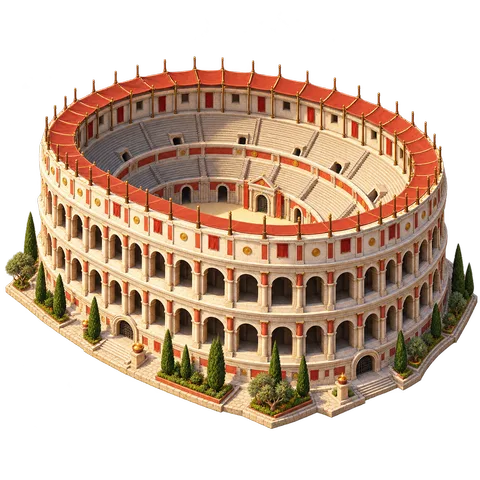
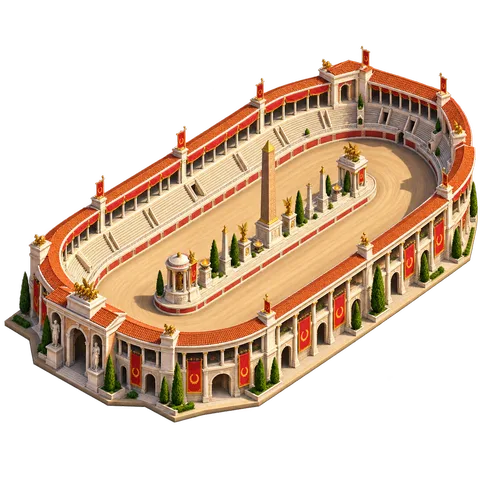
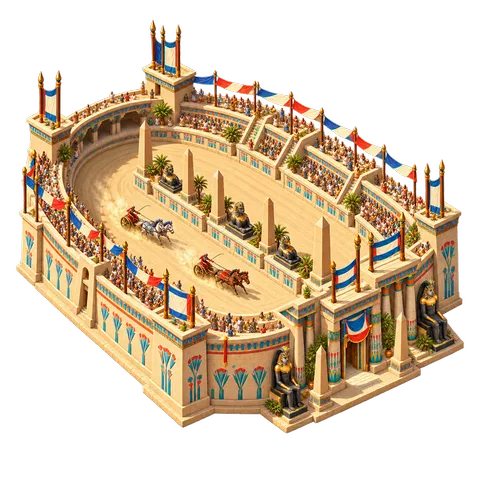
Imagined The arena
In this arena the prizes never run out, and the cheers are for courage, kindness and fair play as much as for winning.
Real world The Pilate Stone
In 1961, archaeologists working in the Roman theater at Caesarea, on the coast of Israel, found a stone carved with the name of Pontius Pilate, "Prefect of Judea". It is one of the very few objects from his own time to name him, and it is now in the Israel Museum in Jerusalem.
Art In this artwork
The illustration shows a white marble stadium with tiers of arches, gold trim, a green field inside and golden laurel wreaths on top.
Look closer
- Find the golden wreaths.
- How many rows of arches can you see?
Think about it
- How do you think Peter felt when the rooster crowed?
- What do you think Jesus meant by "My kingdom is not of this world"?
- Why do you think Jesus let himself be treated this way?
Key words
- Governor
- A ruler sent to govern a region.
- Crucify
- To put to death on a wooden cross, a Roman punishment.
- Mock
- To make fun of someone cruelly.
Sources
Bible quotations are from the Berean Standard Bible, which is in the public domain. The other facts on this page come from these sources:
- The Bible, Gospel of Luke
- The Bible, Gospel of John
- The Bible, Gospel of Mark
- The Bible, First Letter to the Corinthians
- Encyclopaedia Britannica, "Pontius Pilate"
- The Israel Museum, Jerusalem, the Pilate inscription from Caesarea