Real world Why build so tall?
Where land is scarce and expensive, building upward lets a city house many people without spreading outward. Towers can leave more space at ground level for parks and streets, and residents may enjoy views and light.
Tall towers also bring challenges: they cost more to build and maintain, depend on elevators and pumps, and can feel isolating if there are no shared spaces where neighbors meet.
Real world How a tower stands up
A tall building must carry its own weight down to the ground and resist wind pushing on its side. Most towers have a strong central core of concrete, which holds the elevators, stairs and pipes, and acts like a spine. Floors and columns spread out from the core.
Deep foundations, sometimes piles driven or drilled tens of meters into the ground, anchor the tower. Engineers test models in wind tunnels, and some very tall buildings use a tuned mass damper: a huge weight near the top that moves against the sway to keep the building steady.
Real world Living in the sky
Water must be pumped up to the upper floors. Fast elevators are essential, and people need protected stairways for escape in a fire. Building codes for high-rises require sprinklers, fire-resistant construction and refuge floors in the tallest towers.
Art In this artwork
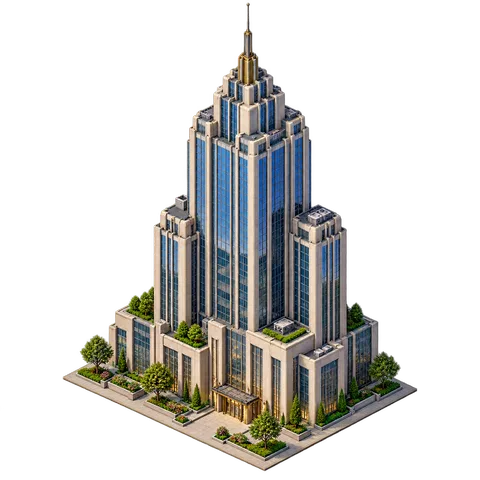
This illustration shows a glass tower with a stepped top. Its design is the artist's own.
Look closer
- Look for the shape of the core and floors through the glass.
- How does the tower get narrower toward the top?
Think about it
- Would you like to live on the 40th floor? What would be good and hard about it?
- What happens in a tower when the power goes out?
- How could a tower help neighbors meet each other?
Key words
- Core
- The strong central part holding elevators and stairs.
- Pile
- A long column driven into the ground to support a building.
- Tuned mass damper
- A heavy weight that reduces swaying.
Sources
The facts on this page are based on these sources:
- Encyclopaedia Britannica, "Skyscraper" and "Elevator"
- Council on Tall Buildings and Urban Habitat, tall building data and research
- National Fire Protection Association, information on sprinklers and fire safety in buildings