Real world Two inventions that changed cities
Before the 1850s, people did not want to climb more than five or six flights of stairs, and walls of thick stone limited how tall buildings could be. Two inventions changed that. In 1854 Elisha Otis demonstrated a safety brake that stopped an elevator from falling if its rope broke, making passenger elevators trustworthy. Then engineers began using frames of iron and steel to carry a building's weight, so walls no longer had to.
The Home Insurance Building in Chicago, completed in 1885, is often called the first skyscraper because of its metal frame.
Real world How a skyscraper works
- A steel or concrete frame carries the weight down to deep foundations.
- A stiff core and bracing resist wind and earthquakes.
- Elevators are grouped into zones, with express elevators to "sky lobbies" in the tallest towers.
- Pumps push water to the top floors.
- Fire safety systems include sprinklers, fire-resistant stairs and pressurized escape routes.
Real world The art deco style
Many skyscrapers of the 1920s and 1930s, such as the Chrysler Building and Empire State Building in New York, were built in the Art Deco style, with stepped tops, vertical lines and decorative metalwork. New York's 1916 zoning law required tall buildings to step back as they rose, so that light and air could still reach the street.
Art In this artwork
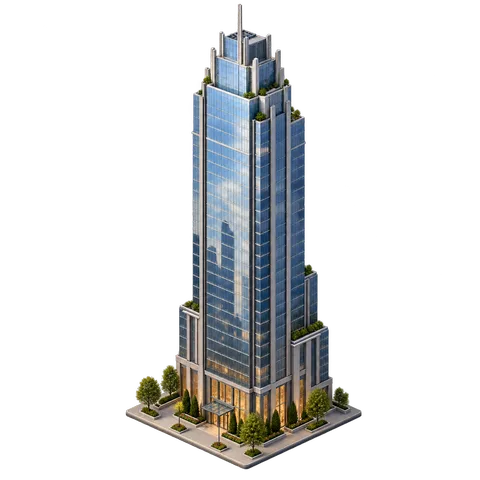
This illustration shows a stepped Art Deco style tower with a spire.
Look closer
- Find the setbacks where the tower steps in as it rises.
- Look at the spire. Is it for people or just for show?
Think about it
- Why do cities build skyscrapers?
- How might a tall building affect the street below: light, wind, crowds?
- What would you put at the top of a skyscraper?
Key words
- Setback
- A step back in the face of a building as it rises.
- Art Deco
- A bold, decorative style from the 1920s and 1930s.
- Sky lobby
- A floor where people change between elevators.
Sources
The facts on this page are based on these sources:
- Encyclopaedia Britannica, "Skyscraper" and "Elevator"
- Council on Tall Buildings and Urban Habitat, tall building data and research