History Building upward
In big towns like Thebes and Memphis, houses crowded together along narrow streets, and some rose several floors. Tomb paintings show tall houses with work going on downstairs and the family living above. Clay models of houses, called soul houses, were placed in tombs; some have stairs leading to an upper floor and a roof terrace.
History Lost under modern cities
We know much more about Egyptian tombs and temples than about town houses. Tombs and temples were built of stone in the dry desert, but towns stood on the river banks, were built of mud brick and often lie under modern towns today.
History A house in a painting
A painting in the tomb of Djehutynefer, a royal scribe at Thebes around 1420 BC, shows his house on three levels joined by stairs, with Djehutynefer and his scribes at work inside. It is one of very few pictures of the inside of an Egyptian town house.
Art In this artwork
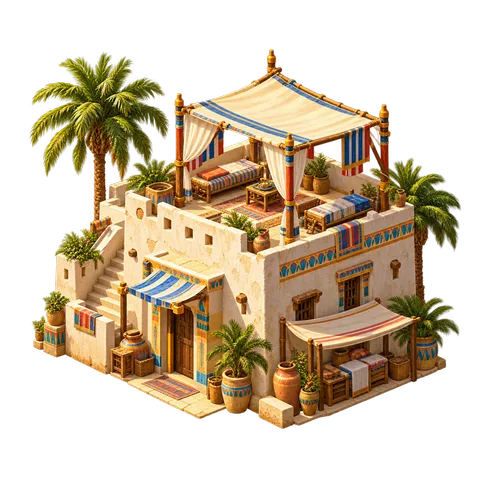
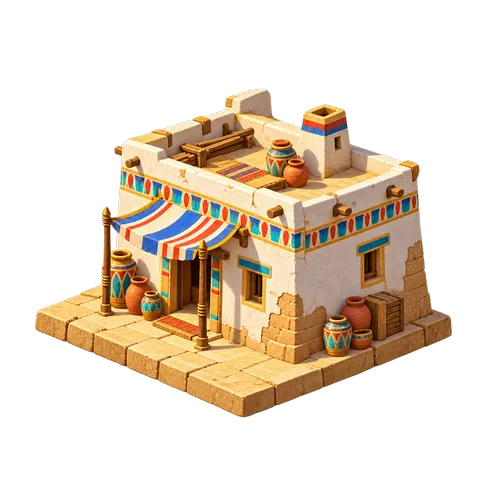
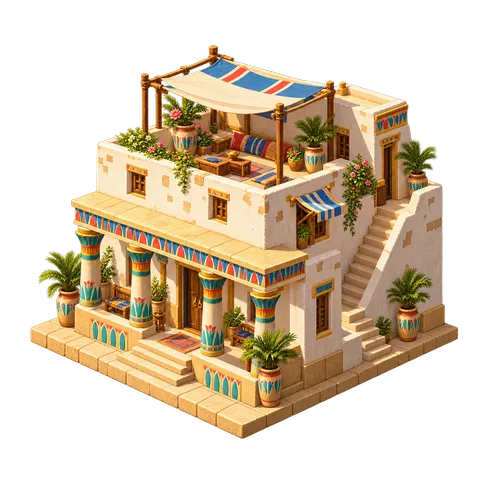
The illustration shows a three-story house of mud brick and sandstone with small windows, a painted blue band and a canopy on the roof.
Look closer
- Count the floors.
- Find the canopy on the roof.
Think about it
- Why do people build upward in crowded places?
- Why do houses last less well than temples?
- How many floors do the homes near you have?
Key words
- Story
- One floor or level of a building, as in "a three-story house".
- Soul house
- A clay model of a house placed in a tomb.
- Terrace
- A flat outdoor space, often on a roof.
Sources
The history on this page is a short summary based on these sources:
- Petrie Museum of Egyptian Archaeology, University College London, pottery "soul house" models
- Tomb of Djehutynefer (TT104), Thebes: painting of his house, about 1420 BC
- Barry Kemp, The City of Akhenaten and Nefertiti: Amarna and Its People (2012)
- Ian Shaw (editor), The Oxford History of Ancient Egypt (2000)