Real world What is space weather?
The Sun constantly sends out a stream of particles called the solar wind. Sometimes it erupts with solar flares and huge clouds of charged gas called coronal mass ejections. When these reach Earth they can cause beautiful auroras, but also disrupt satellites, radio, GPS and power grids.
In 1859, a powerful solar storm, known as the Carrington Event, produced auroras seen far from the poles and caused sparks and fires on telegraph lines.
Real world Forecasting today
Organizations such as the US NOAA Space Weather Prediction Center use satellites that watch the Sun and measure the solar wind upstream of Earth to give warnings, from a few days to less than an hour ahead, depending on the event.
Possible future On the Moon or Mars
Without a protective magnetic field, a settlement would rely on warnings to send people into the storm shelter and to protect electronics. A local station would measure radiation levels and particles, and combine its readings with data from spacecraft watching the Sun.
Art In this artwork
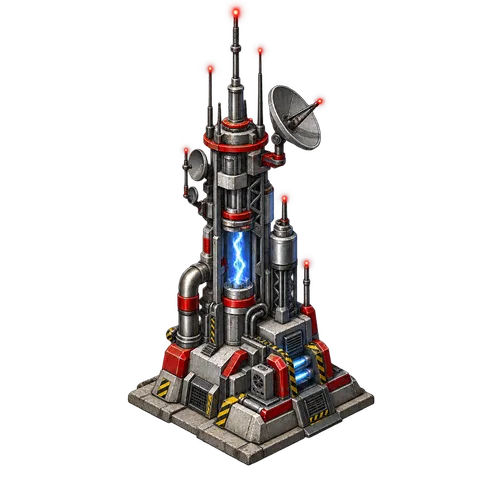
This illustration shows a slender tower with antennas, dishes and red warning lights.
Look closer
- Count the sensors and dishes on the tower.
- Find the warning lights.
Think about it
- What would happen to a settlement if communications failed during a solar storm?
- How could space weather affect your life on Earth?
- Why are auroras linked to the Sun?
Key words
- Solar flare
- A sudden burst of energy from the Sun.
- Coronal mass ejection
- A huge cloud of charged gas thrown out by the Sun.
- Aurora
- Glowing lights in the sky near the poles.
Sources
The real-world facts on this page are based on these sources:
- NOAA Space Weather Prediction Center, space weather and the 1859 Carrington Event
- NASA, "Space Weather" (Heliophysics Division)