Real world How deep space communication works
NASA talks to distant spacecraft through the Deep Space Network: giant dish antennas at three sites, in California, Spain and Australia, spaced around the world so at least one can always see a spacecraft as Earth turns.
Rovers on Mars usually send their data to orbiters passing overhead, such as the Mars Reconnaissance Orbiter, which relay it to Earth with more powerful antennas.
Real world The speed-of-light delay
Radio waves travel at the speed of light, but Mars is so far away that a message takes roughly 3 to 22 minutes to arrive, depending on where the planets are in their orbits. A reply takes just as long again. Live conversation is impossible; messages work more like letters.
Possible future Building and maintaining it
A settlement tower would hold dishes for talking to orbiters, low-power antennas for suits and rovers nearby, and perhaps lasers for very fast data. It would need to survive dust, cold and radiation, with spare antennas and automatic switching if one fails.
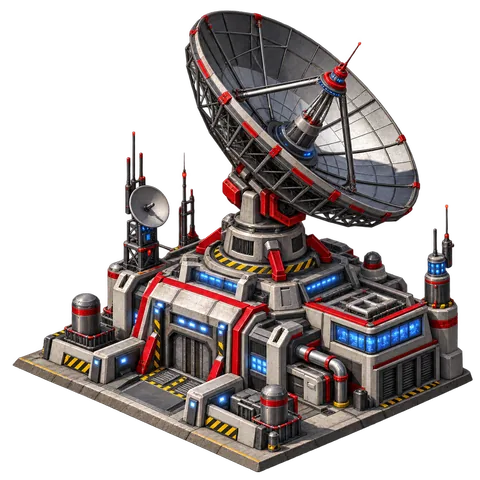
Art In this artwork
This illustration shows a tall tower with antennas and dishes and glowing blue energy at its base.
Look closer
- Count the antennas and dishes.
- Why might the tower be tall?
Think about it
- How would you chat with a friend on Mars if each message took 20 minutes?
- What would happen to a settlement if communications failed?
- Why does NASA need antennas on three continents?
Key words
- Relay
- Passing a message along.
- Signal delay
- The time it takes for a message to arrive.
- Bandwidth
- How much data can be sent at once.
Sources
The real-world facts on this page are based on these sources:
- NASA, "Deep Space Network" and Mars relay orbiters
- Encyclopaedia Britannica, "Speed of light"