Real world Medicine far from home
On the International Space Station, a crew in trouble can return to Earth within hours. From the Moon it takes days; from Mars, many months. A settlement would need its own medical bay and crew members trained to handle emergencies.
NASA's Human Research Program studies five main hazards of spaceflight: radiation, isolation and confinement, distance from Earth, altered gravity and hostile, closed environments. Each one affects health.
Possible future How it would work
- Compact equipment such as portable ultrasound, blood analysers and X-ray machines.
- Doctors on Earth giving advice over video, though messages to Mars take minutes to arrive.
- Artificial intelligence to help diagnose problems.
- A pharmacy with medicines that stay stable for years despite radiation.
- Care for mental health as well as physical health.
Real world Learning from today
Astronauts have performed ultrasound scans on each other on the space station, guided step by step by experts on the ground. Similar telemedicine helps people in remote places on Earth, such as Antarctic research bases and rural villages.
Art In this artwork
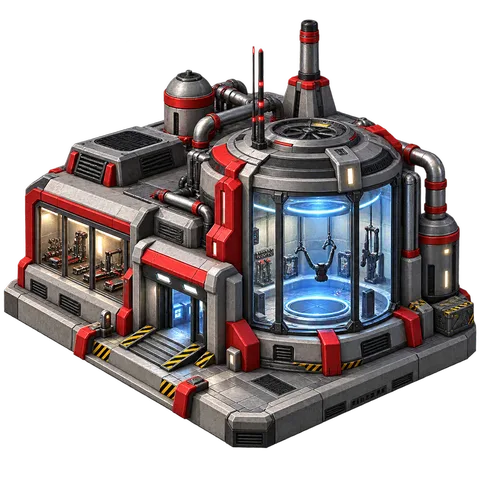
This illustration shows a building with glass walls and machinery. Here we imagine it as the settlement's medical bay.
Look closer
- Find the glass walls. Why might a medical bay need lots of light?
- Where might an emergency vehicle arrive?
Think about it
- What medical skills should everyone in a settlement learn?
- How could doctors help when messages take 20 minutes to arrive?
- Why is mental health important on long missions?
Key words
- Telemedicine
- Medical care given at a distance using technology.
- Diagnose
- Work out what illness someone has.
- Ultrasound
- A scan that uses sound waves to see inside the body.
Use it in class
- Design a Mars colony: a student project (Project, grades 5-12)
- How do astronauts live on the International Space Station? (Explainer, grades 3-12)
Sources
The real-world facts on this page are based on these sources:
- NASA Human Research Program, hazards of human spaceflight (radiation, isolation, distance, gravity, hostile environments)
- NASA, "Advanced Diagnostic Ultrasound in Microgravity" (ADUM) experiment on the International Space Station