History A comfortable home
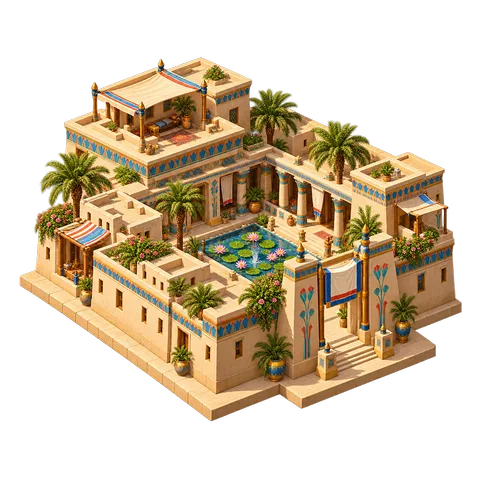
People with good jobs, such as scribes and officials, lived in larger houses. Walls were plastered and painted, and a main room had wooden columns holding up the roof. Furniture included beds, chairs, chests and small tables. Instead of soft pillows, people slept with their head on a curved headrest of wood or stone.
History Keeping cool
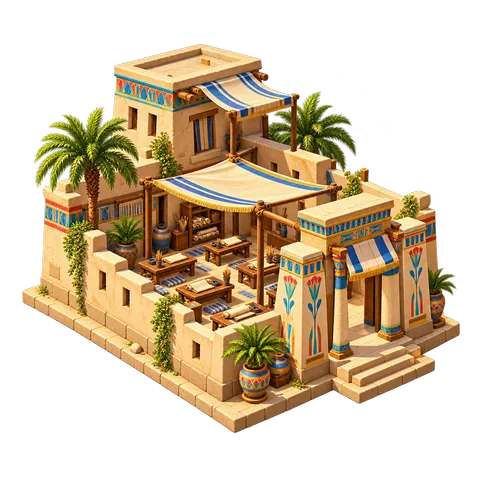
Thick walls kept out the heat, and windows were small and set high up to let out hot air and keep out dust and glare. Porches gave shade, and houses were often built to catch the cool breeze that blows from the north.
History Gods at home
Families prayed at home as well as in temples. Many houses had a niche in the wall for a small statue of a household god, such as Bes, who was thought to scare away snakes and bad dreams, or Taweret, a hippopotamus goddess who protected mothers and babies.
Art In this artwork
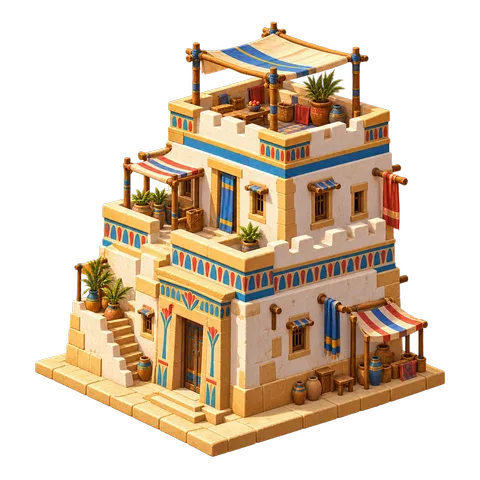
The illustration shows a two-story whitewashed house with a columned porch, an awning on the roof and pots of flowers.
Look closer
- Find the columns of the porch.
- Look for the flower pots.
Think about it
- How did Egyptian houses stay cool without air conditioning?
- What would it be like to sleep on a headrest?
- How are homes near you kept cool or warm?
Key words
- Porch
- A covered area at the entrance of a house.
- Headrest
- A curved stand for the head, used instead of a pillow.
- Official
- A person who works for the government.
Sources
The history on this page is a short summary based on these sources:
- Barry Kemp, The City of Akhenaten and Nefertiti: Amarna and Its People (2012)
- Encyclopaedia Britannica, "Tell el-Amarna"
- Ian Shaw (editor), The Oxford History of Ancient Egypt (2000)