History What it was
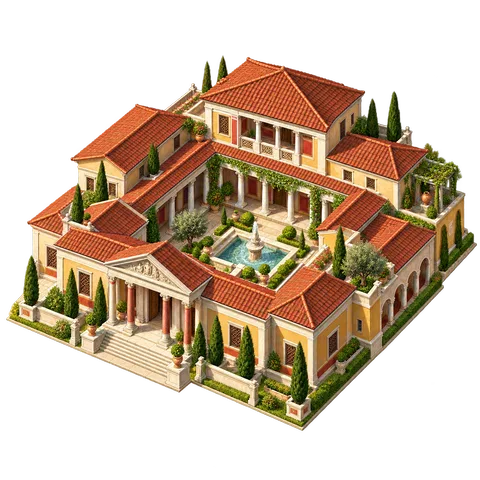
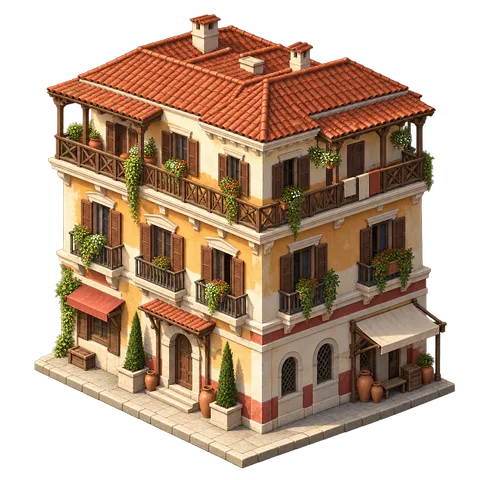
Wealthier Romans lived in a domus, a single-family house. From the street a domus looked plain, often with shops built into the front wall. Inside, it opened up into bright, decorated rooms arranged around open spaces.
History A walk through a domus
- Fauces ("jaws"): the narrow entrance passage.
- Atrium: a large hall with an opening in the roof. Rain fell through into a shallow pool, the impluvium, and was stored in a tank below.
- Tablinum: the owner's office, between the atrium and the garden.
- Triclinium: the dining room, where diners reclined on couches.
- Cubicula: small bedrooms.
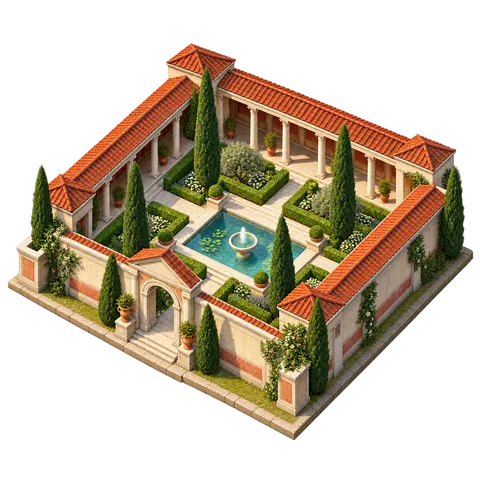
- Peristyle: a garden surrounded by a covered colonnade.
History A home and a workplace
A domus was not only a private home. Each morning, people who depended on the owner, called clients, came to greet him and ask for help or favors. The atrium was designed to impress them, with family portraits, fine paintings and a view straight through the house to the garden.
The household included the family, but also enslaved workers who cooked, cleaned and served.
History Places you can still see
Pompeii and Herculaneum, buried by the eruption of Mount Vesuvius in AD 79, preserve many town houses. The House of the Faun in Pompeii is named after a bronze dancing statue found in its atrium, and the House of the Tragic Poet has a famous floor mosaic of a dog with the words "cave canem" ("beware of the dog").
Art In this artwork
This is a general illustration of a domus, not a specific house. Real town houses were usually squeezed tightly between neighbors.
Look closer
- Find the pool in the middle of the house.
- Where does the light come in?
Think about it
- This house faces inward. What are the benefits of that?
- Why would a home be designed to impress visitors?
- How is collecting rainwater useful?
Key words
- Atrium
- The main hall, open to the sky.
- Impluvium
- The pool that catches rainwater.
- Peristyle
- A garden surrounded by columns.
Use it in class
- What was daily life like in ancient Rome? (Explainer, grades 5-12)
Sources
The history on this page is a short summary based on these sources:
- Smarthistory, "Roman domestic architecture: the domus"
- UNESCO World Heritage Centre, "Archaeological Areas of Pompei, Herculaneum and Torre Annunziata"