History The useful palm
Dates were eaten fresh or dried, pressed into cakes and used to sweeten food, since honey was costly. Nothing went to waste: palm leaves were woven into baskets, mats, sandals and brooms, the fibers twisted into rope, and the trunks used as roof beams. The doum palm, whose trunk splits into branches, also gave fruit; doum nuts were placed in the tomb of Tutankhamun.
History Three seasons
Egyptian farmers divided the year into three seasons: the flood, when the fields lay under water; the growing season, when they plowed and sowed in the wet mud; and the harvest. Canals and basins held floodwater so that fields and palm groves could be watered for longer.
History A goddess in a tree
Trees were so precious that Egyptians linked them with the gods. Some tomb paintings show a goddess appearing out of a sycamore fig tree, pouring cool water and offering bread to the dead, just as a tree gives shade and fruit to the living.
Art In this artwork
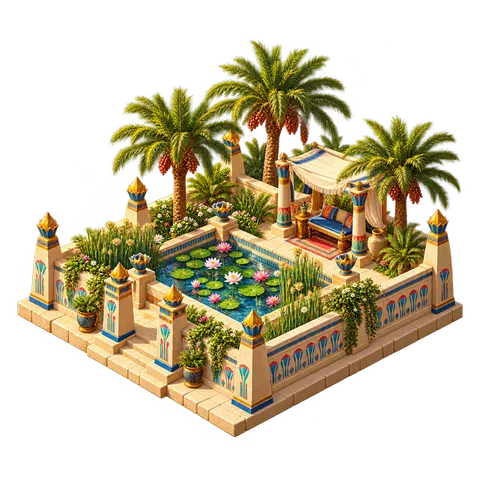
The illustration shows three date palms heavy with fruit beside a small water channel with a low mud-brick edge.
Look closer
- Find the clusters of dates.
- Follow the water channel.
Think about it
- How many things can you make from one kind of tree?
- Why would farmers dig canals?
- Which plants are most useful where you live?
Key words
- Date
- The sweet fruit of the date palm.
- Canal
- A man-made channel for water.
- Season
- One of the parts of the year.
Sources
The history on this page is a short summary based on these sources:
- Encyclopaedia Britannica, "Nile River"
- Encyclopaedia Britannica, "Ancient Egypt"
- Ian Shaw (editor), The Oxford History of Ancient Egypt (2000)