Possible future How it would work
An indoor farm would grow leafy greens, herbs, tomatoes, peppers and more in stacked trays, watered with nutrient solution and lit by LEDs tuned to the colors plants use best. Computers would control temperature, humidity and light. Fresh food would add vitamins and variety to packaged meals.
Real world Plants in space today
NASA's Veggie system on the International Space Station grows plants under red, blue and green LEDs. In 2015, astronauts ate red romaine lettuce grown on the station, the first time NASA astronauts ate food grown in space. Since then crews have grown cabbage, mustard greens, chilli peppers and flowers.
Growing plants in weightlessness has surprises: water does not drain downward, so roots can drown or dry out, and plants rely on light rather than gravity to know which way to grow.
Real world Indoor farms on Earth
"Vertical farms" in cities grow crops indoors in stacked layers, using much less water than fields because water is recycled. They are good for leafy greens but use a lot of electricity for lights, so engineers are working to make them more efficient.
Art In this artwork
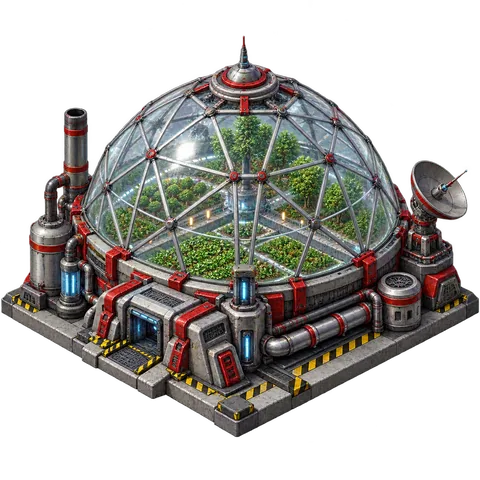
This illustration shows raised trays of green plants under lights, surrounded by machinery.
Look closer
- Notice the lights above the plants.
- Find the tanks that might hold water and nutrients.
Think about it
- Should food be grown inside cities? What would it need?
- Why might astronauts value fresh food more than people on Earth?
- Which foods would be hardest to grow indoors?
Key words
- Hydroponics
- Growing plants in water and nutrients without soil.
- LED
- A light-emitting diode, an efficient kind of light.
- Vertical farm
- An indoor farm with crops in stacked layers.
Use it in class
- How could humans live on Mars? (Explainer, grades 5-12)
- How do astronauts live on the International Space Station? (Explainer, grades 3-12)
Sources
The real-world facts on this page are based on these sources:
- NASA, "Veggie" plant growth system on the International Space Station
- Encyclopaedia Britannica, "Hydroponics"