History What it was
Romans worshipped many gods and goddesses, and a temple was thought of as the home of a particular god. Inside, a room called the cella held the god's statue and valuable gifts. Ordinary people did not gather inside for services as in many modern places of worship.
History How it worked
Roman temples usually stood on a tall platform called a podium, reached by a flight of steps at the front only. This made the temple face one direction, looking out over a square or forum. A deep porch of columns led to the doors of the cella.
Religious ceremonies, including prayers and animal sacrifices, took place at an altar outside, in front of the steps, where crowds could watch. Priests and officials led the rituals on festival days.
History Places you can still see
The Maison Carrée in Nîmes, France, built around the turn of the 1st century AD, is one of the best-preserved Roman temples anywhere and still has its roof. In Rome, the Temple of Portunus beside the river Tiber shows the same plan on a small scale. The most important temple in Rome stood on the Capitoline Hill, dedicated to Jupiter, Juno and Minerva.
Art In this artwork
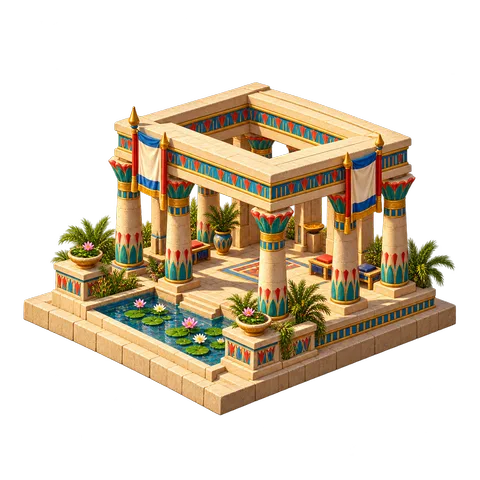
The golden statue on the roof and the colors are the artist's interpretation, though Roman temples were often brightly painted and decorated with statues.
Look closer
- Count the columns across the front.
- Find the statue on top of the roof.
Think about it
- Why might a temple be built on a high platform?
- How is this different from places of worship you know?
- Why do you think public ceremonies happened outside?
Key words
- Cella
- The inner room holding the god's statue.
- Podium
- The high platform a temple stands on.
- Pediment
- The triangle shape above the columns at the front.
Sources
The history on this page is a short summary based on these sources:
- Smarthistory, "Temple of Portunus, Rome"
- UNESCO World Heritage Centre, "Maison Carrée of Nîmes"
- Encyclopaedia Britannica, "Roman Forum"