History The door to a god's house
A temple was thought of as the home of a god, and its front door was a pylon: two tall stone towers with sloping walls and a gateway between them. The shape echoed the Egyptian sign for the horizon, two hills with the sun rising between them.
Carvings on the towers usually showed the king defeating Egypt's enemies, a message that chaos was kept outside. Tall wooden flagpoles with colored banners stood in grooves on the front.
History Gates within gates
Big temples grew over hundreds of years as each king added something new. The temple of Amun at Karnak has ten pylons. Its first pylon, about 113 meters wide, was never finished, and remains of the builders' mud-brick ramp can still be seen behind it. At Edfu, a later temple from the time of the Ptolemy kings, the pylon is complete and stands about 36 meters tall.
Art In this artwork
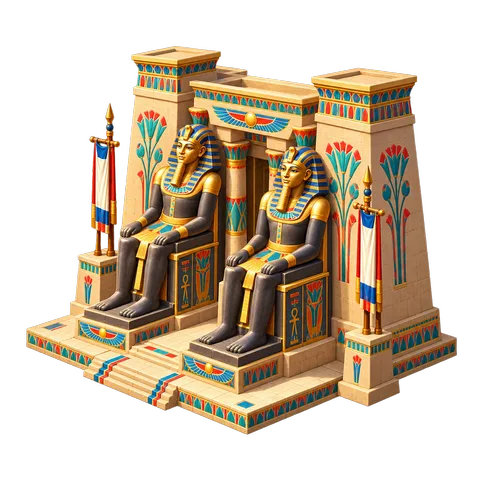
The illustration shows a pylon with seated statues and red and blue banners on tall poles. The bright colors are a good guess: traces of paint show that temples were once brightly painted.
Look closer
- Count the flagpoles.
- Find the seated statues by the door.
Think about it
- Why might a temple have such a huge front door?
- What do big entrances to buildings near you say to visitors?
- Why did each king want to add to the temple?
Key words
- Pylon
- A temple gateway with two sloping towers.
- Horizon
- The line where the land seems to meet the sky.
- Relief
- A carving that stands out from a flat surface.
Sources
The history on this page is a short summary based on these sources:
- Encyclopaedia Britannica, "Pylon"
- Encyclopaedia Britannica, "Karnak"
- UNESCO World Heritage Centre, "Ancient Thebes with its Necropolis"
- Richard H. Wilkinson, The Complete Temples of Ancient Egypt (2000)