History What it was
Every government needs somewhere safe to keep its money. In Rome, the state treasury (the aerarium) was kept in the Temple of Saturn in the Roman Forum, together with a nearby records office. The first temple on the site dates back to the early years of the Republic, around 497 BC.
The treasury was more than a vault. It also kept copies of laws, decisions of the Senate and other official documents, so it worked as an archive too.
History How it worked
During the Republic the treasury was managed by junior officials called quaestors, under the control of the Senate. Money came in from taxes, from the provinces and from the spoils of war, and went out to pay for armies, roads, buildings and public games.
In AD 6 the emperor Augustus set up a separate military treasury to pay soldiers' pensions. The old treasury, still known as the aerarium Saturni, later became mainly the treasury of the city of Rome.
History Roman money
Romans paid with coins. The silver denarius was the everyday coin of value, the gold aureus was worth much more, and smaller coins of bronze and brass were used for daily shopping. Coins carried the portrait of the emperor and short messages, so they also spread news and propaganda across the empire.
History What you can see today
Eight tall columns of the Temple of Saturn still stand at the edge of the Roman Forum. They belong to a rebuilding from the 4th century AD.
Art In this artwork
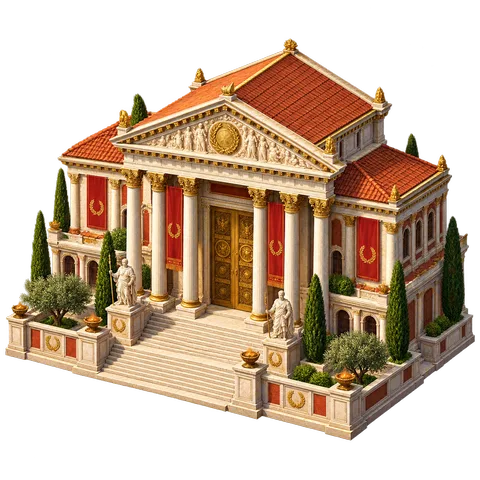
This illustration stands for the treasury. Its banners and decoration are the artist's own; the real Temple of Saturn was a tall columned temple on a high base.
Look closer
- Look for the strong doors and high steps.
- What makes a building look safe and important?
Think about it
- Why might Romans keep public money in a temple?
- What does a government spend money on today?
- Why would a ruler put their own face on coins?
Key words
- Aerarium
- The state treasury.
- Quaestor
- An official in charge of public money.
- Denarius
- A Roman silver coin.
Sources
The history on this page is a short summary based on these sources:
- Encyclopaedia Britannica, "Aerarium"
- Smarthistory, "The Roman Forum (Forum Romanum)"
- Encyclopaedia Britannica, "Roman Forum"