History A resting place for the gods
At big festivals, priests carried a statue of the god out of the temple in a small shrine shaped like a boat. Along the route stood open pavilions, or kiosks, where they could set the shrine down and rest. The White Chapel at Karnak, built for King Senusret I around 1950 BC, is one of these way stations. Later kings took it apart and used its blocks to fill a pylon; archaeologists found the pieces and rebuilt it in the 1930s.
History Saved from the water
Kiosks also stood at temple entrances and on river banks. Trajan's Kiosk on the island of Philae, built when Egypt was part of the Roman Empire, has 14 tall columns with flower-shaped tops. In the 1970s, Philae's temples were taken apart and rebuilt, stone by stone, on a higher island to save them from the rising water behind the Aswan High Dam.
Art In this artwork
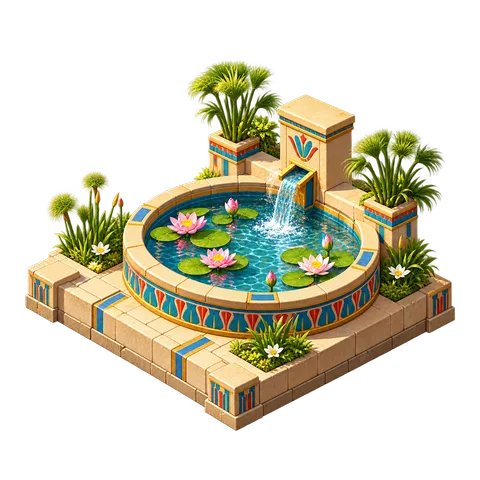
This pavilion of lotus-topped columns around a small pool is the artist's idea. Real kiosks had similar columns with plant-shaped tops.
Look closer
- Look at the tops of the columns.
- Find the pool in the middle.
Think about it
- Why might a festival route need resting places?
- How would you move a whole temple to save it?
- Where do people rest along busy routes near you?
Key words
- Kiosk
- An open pavilion with columns.
- Shrine
- A small holy place for a god's statue.
- Procession
- A group moving along a route for a ceremony.
Sources
The history on this page is a short summary based on these sources:
- Encyclopaedia Britannica, "Karnak"
- UNESCO World Heritage Centre, "Nubian Monuments from Abu Simbel to Philae"
- Richard H. Wilkinson, The Complete Temples of Ancient Egypt (2000)