Real world Why towns have public libraries
A public library is one of the few indoor places anyone can enter and stay without buying anything. The IFLA-UNESCO Public Library Manifesto describes it as a local gateway to knowledge, open to all regardless of age, background or income.
Between 1883 and 1929, the industrialist Andrew Carnegie paid for 2,509 library buildings around the world, most of them in the United States, on condition that towns provided the land and paid to run them. Many are still in use.
Real world What a library does today
- Lends books, e-books, films, music and sometimes tools or musical instruments.
- Provides free computers and Wi-Fi, which helps people apply for jobs and services online.
- Runs story times for young children and homework help for students.
- Offers classes in languages, digital skills and more.
- Gives everyone a warm, safe, quiet place to read or study.
Real world Designing a library
Modern libraries mix quiet reading rooms with lively spaces for children, meeting rooms and maker spaces. They need strong floors to carry heavy shelves, good daylight without sun glare on pages, and step-free access throughout.
Art In this artwork
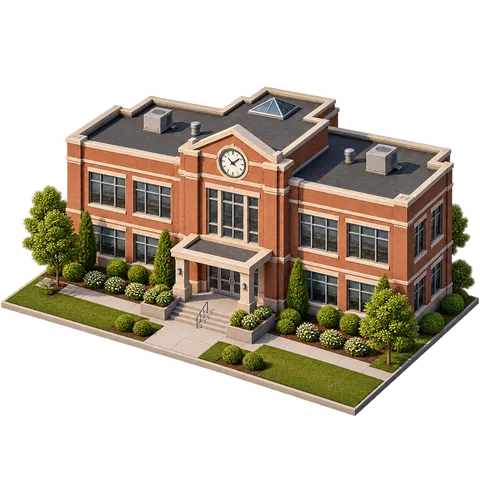
This illustration shows a brick library with a carved open book above the entrance.
Look closer
- Find the open book above the door.
- Is there a step-free way in?
Think about it
- Who might rely on a public library the most?
- Why is it important that some places are free to enter?
- What would you add to a library of the future?
Key words
- Literacy
- Being able to read and write.
- Digital divide
- The gap between people who can and cannot get online.
- Lending
- Letting people borrow things for a while.
Use it in class
- What makes a good place to live? Discussion questions (Lesson, grades 5-12)
- Free images for the classroom: how to use and credit them (Guide, grades Teachers, 6-12)
- Explore your town: a neighborhood walk and scavenger hunt (Lesson, grades K-8)
Sources
The facts on this page are based on these sources:
- IFLA-UNESCO Public Library Manifesto (2022)
- Digital Public Library of America, exhibition "A History of US Public Libraries: Carnegie Libraries"