Possible future How it would work
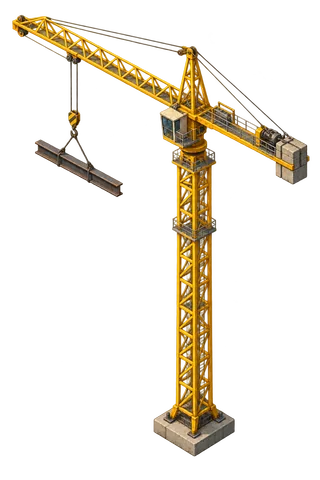
A robotic crane would unload landers, stack habitat modules and pile soil over shelters, guided by cameras and sensors and supervised by people from inside the base.
Real world Lighter, but not easier
On the Moon, gravity is about one sixth as strong as on Earth, so a load weighs only a sixth as much: a crane can lift much heavier objects. But an object's mass, its amount of matter, stays the same. A heavy module swinging on a cable is just as hard to start and stop as on Earth, so it could swing for a long time and crash into things. Cranes would need to move slowly and carefully, with ways to damp the swinging.
Lower gravity also means less grip: a crane needs a wide base or anchors, so it does not tip or slide when it swings a load.
Possible future Building and maintaining it
The crane would be designed to fold for launch and set itself up on arrival. Its motors and joints would need sealing against dust, and its cables would need regular inspection. Remote operators could control it from inside the base, or even from Earth for slow, careful jobs.
Art In this artwork
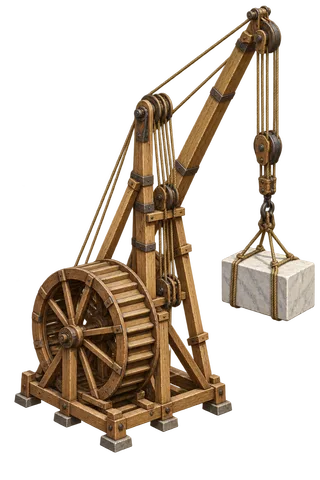
This illustration shows a red and gray robotic crane lifting a glowing module. The glow is part of the original artwork.
Look closer
- Is anyone operating it? How can you tell?
- Find the glowing module on the hook.
Think about it
- If machines did most building work, what work would people still choose to do?
- Why might a swinging load be dangerous on the Moon?
- What is the difference between weight and mass?
Key words
- Mass
- How much matter an object has.
- Weight
- The force of gravity pulling on an object.
- Inertia
- An object's resistance to starting or stopping.
Sources
The real-world facts on this page are based on these sources:
- NASA and Canadian Space Agency, Canadarm2, Robonaut 2 and Astrobee robots
- NASA, Artemis program overview, including Gateway and plans for a lunar base camp