Imagined What it could do
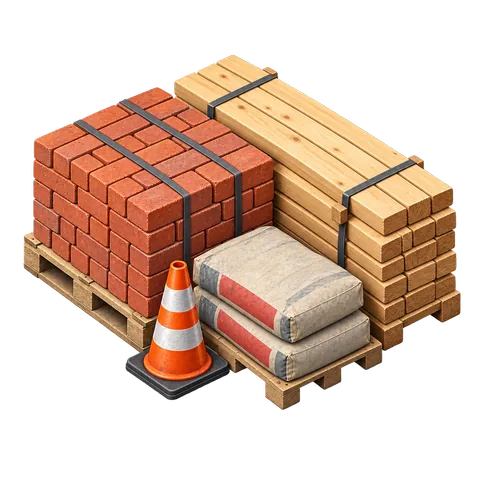
Imagine builders who take only what the forest can spare: fallen timber, loose stone and glass melted from sand and old bottles, and who ask of every material, "how would nature do this?"
Real world Learning from 3.8 billion years of design
Life on Earth has been solving problems for billions of years. Biomimicry is the practice of learning from nature's designs to solve human problems. The biologist Janine Benyus made the word popular in her 1997 book.
- Velcro: invented after the engineer George de Mestral looked closely at burrs that stuck to his dog's fur.
- The lotus effect: lotus leaves stay clean because tiny bumps make water roll off, carrying dirt. This inspired self-cleaning paints and glass.
- The bullet train: Japan's Shinkansen engineers reshaped a train's nose to be more like a kingfisher's beak, making it quieter when leaving tunnels.
- Termite-inspired cooling: see the Breathing spire page.
Bible Wisdom in creation
People who copy nature are learning from the work of its Maker. A psalm says: "How many are Your works, O LORD! In wisdom You have made them all; the earth is full of Your creatures" (Psalm 104:24).
Real world Low-carbon materials
The materials a building is made from carry hidden "embodied carbon" from mining, making and transport. Timber, straw, earth, reused bricks and recycled steel usually carry much less than new concrete and steel. Choosing them, and designing buildings to be taken apart and reused, can cut a building's climate impact. Glass is made by melting sand, soda ash and limestone, and it can be recycled again and again.
Art In this artwork
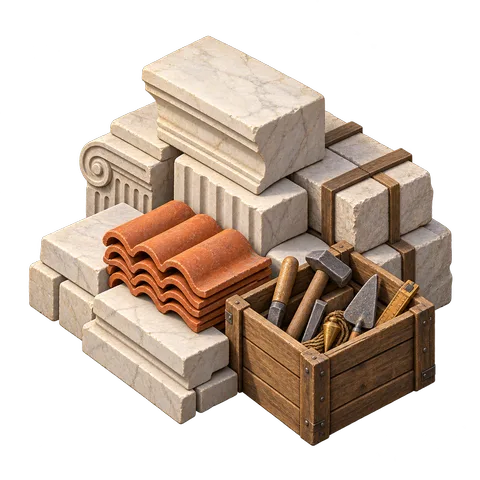
This illustration shows carved white stone, timber logs and a basket of blue glass pieces.
Look closer
- Which materials here would grow back, and which would not?
- Find the basket of glass.
Think about it
- What problem could you solve by copying a plant or animal?
- How could builders take only what nature can replace?
- Why might a material made nearby be better for the planet?
Key words
- Biomimicry
- Learning from nature's designs to solve human problems.
- Embodied carbon
- Emissions from making and moving materials.
- Lotus effect
- Self-cleaning caused by water rolling off a bumpy surface.
Use it in class
- Biomimicry examples for students (Explainer, grades 4-12)
Sources
The real-world facts on this page are based on these sources:
- Janine Benyus, "Biomimicry: Innovation Inspired by Nature" (1997)
- Biomimicry Institute, AskNature database of nature-inspired design
- Wilhelm Barthlott and Christoph Neinhuis, "Purity of the sacred lotus" (1997), on the lotus effect
- US Environmental Protection Agency, "Glass: Material-Specific Data"
- The Bible, Psalms