History Slow but strong
Oxen are cattle trained to work. They are slower than horses, but strong, calm and cheaper to feed, so Romans used them to pull plows and heavy carts. A loaded ox cart moved at about walking pace.
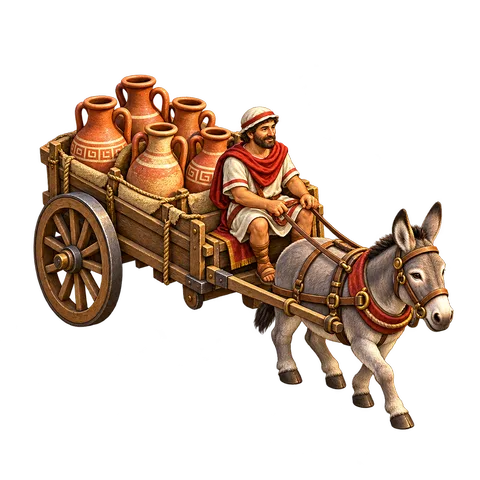
Most carts had solid wooden wheels or wheels with spokes, fixed to an axle. Without springs, the ride was bumpy, so passengers who could afford it preferred other ways to travel.
History Roads built for wheels
Romans built a network of paved roads across their empire, starting with the Via Appia in 312 BC. Roads had layers of stone and gravel, a curved surface so rain drained off, and milestones that showed the distance. They were built mainly for armies, but traders, carts and travelers used them too.
History Carts at night
Rome's streets were narrow and crowded. A law from the time of Julius Caesar banned most wagons from the city during the day, with exceptions such as carts carrying materials for public buildings. So deliveries happened at night, and the poet Juvenal complained that the rumble of wagons kept people awake.
Art In this artwork
This illustration shows a cart of barrels pulled by two oxen. Barrels were used in the northern provinces, while Mediterranean traders more often used clay jars called amphorae.
Look closer
- How many oxen are pulling the cart?
- Look at the wheels. What are they made of?
Think about it
- Why might a city ban delivery carts during the day?
- What problems do delivery trucks cause in cities today?
- Why would a farmer choose oxen instead of horses?
Key words
- Plaustrum
- A heavy Roman farm wagon.
- Axle
- The rod that joins two wheels.
- Milestone
- A stone marking the distance along a road.
Sources
The history on this page is a short summary based on these sources:
- Encyclopaedia Britannica, "Roman road system"
- Encyclopaedia Britannica, "Appian Way"
- Tabula Heracleensis (Lex Julia Municipalis, about 45 BC), rules on wagons in the streets of Rome
- Juvenal, Satires, Book 1, Satire 3 (on traffic noise in Rome at night)