History Donkeys and mules
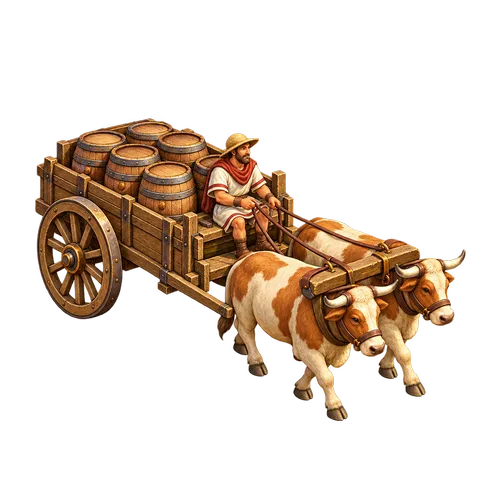
Donkeys and mules carried much of the Roman world's goods, either in carts or with packs on their backs. A mule is the offspring of a donkey and a horse: strong, sure-footed and hardy.
The emperor Augustus set up a state transport service, the cursus publicus, with stations along the main roads where officials could change animals and vehicles. It carried government messages, officials and goods.
History Jars for everything
Romans shipped olive oil, wine and fish sauce in clay jars called amphorae. They had pointed bottoms that could be pushed into sand or stacked in a ship's hold, and two handles for carrying.
Used olive oil amphorae were often broken and thrown away. In Rome, a whole hill called Monte Testaccio is made of pieces of tens of millions of them. Stamps and writing on the pieces tell historians where the oil came from.
Art In this artwork
This illustration shows a donkey pulling a cart full of amphorae. The bright clothes and decoration are the artist's interpretation.
Look closer
- Count the amphorae in the cart.
- Look at the shape of the jars. How would they stand up?
Think about it
- Why would traders use clay jars instead of boxes?
- What does a hill of old jars tell us about Roman trade?
- What do we throw away today that could tell future historians about us?
Key words
- Amphora
- A two-handled clay jar for oil or wine.
- Mule
- The offspring of a donkey and a horse.
- Cursus publicus
- The Roman state transport service.
Sources
The history on this page is a short summary based on these sources:
- Encyclopaedia Britannica, "Cursus publicus" (the Roman state transport service)
- University of Barcelona, CEIPAC research project on Monte Testaccio and Roman amphorae
- Encyclopaedia Britannica, "Roman road system"