Imagined What it could do
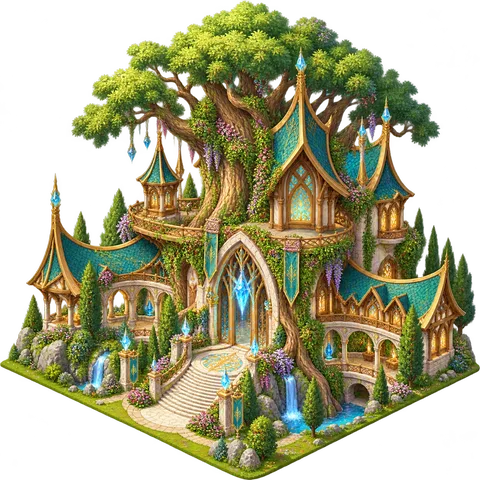
Imagine a tower lit not by electricity but by living things that glow, like fireflies and forest fungi, softly lighting the paths of the elven city at night.
Real world Nature's own light
Bioluminescence is light made by living things. Fireflies flash to find mates, many deep-sea creatures glow, and some fungi make forests glow faintly green at night, sometimes called "foxfire". The light comes from a chemical reaction in which a molecule called luciferin reacts with oxygen, helped by an enzyme called luciferase.
Real world Glowing plants
Scientists discovered how a glowing mushroom makes its light, and added those genes to plants. In 2023, the US Department of Agriculture concluded that a glowing petunia developed by the company Light Bio could be safely grown, and it went on sale in 2024. Its flowers glow softly in a dark room.
Possible future Could living light replace lamps?
Not yet. Today's glowing plants are far too dim to light a street. Scientists would need to make them much brighter, and people would need to think carefully about releasing modified plants outdoors. For now, living light is a beautiful glimpse of what biology might do.
Art In this artwork
This illustration shows a tall stone tower with blue glass windows, climbing vines and a blue glass lantern on top.
Look closer
- Find the blue glass lantern on top.
- What color is the light?
Think about it
- Would you want a garden that glows at night?
- What should we think about before changing the genes of plants?
- Why do so many deep-sea animals make light?
Key words
- Bioluminescence
- Light made by living things.
- Gene
- Instructions inside a cell that shape how a living thing grows.
- Enzyme
- A molecule that speeds up a chemical reaction.
Use it in class
- Biomimicry examples for students (Explainer, grades 4-12)
Sources
The real-world facts on this page are based on these sources:
- US Department of Agriculture, Animal and Plant Health Inspection Service, review of Light Bio's "Firefly Petunia" (2023)
- Janine Benyus, "Biomimicry: Innovation Inspired by Nature" (1997)