Real world Why not just solar?
Solar panels work well in space, and the International Space Station runs on them. But much of the Moon has about two weeks of darkness at a time, and Mars is further from the Sun, with dust storms that can block sunlight for weeks. A settlement needs power for life support at every moment.
Real world A small nuclear reactor
In 2018, NASA and the US Department of Energy tested a small reactor called KRUSTY, part of the Kilopower project, in Nevada. It ran successfully through a full power cycle. NASA's Fission Surface Power project builds on this, aiming for a reactor that could provide around 40 kilowatts on the Moon, enough for several homes on Earth, for about ten years.
Possible future Building and maintaining it
- The reactor would be landed and placed away from the habitat, or buried, so soil blocks its radiation.
- Radiators, like big fins, would get rid of waste heat into space.
- Cables would carry power to the base.
- It would be designed to run for years with very little maintenance.
- Solar panels and batteries would provide backup.
Art In this artwork
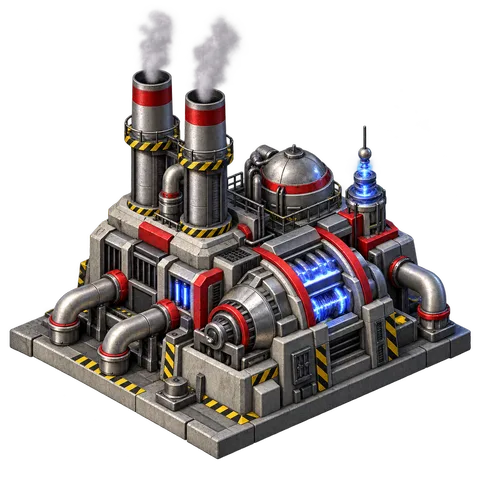
This illustration shows a tall tower crackling with blue energy. Here we imagine it as the settlement's power plant.
Look closer
- Follow the cables from the tower.
- Find the coils at the top.
Think about it
- Where should a city's energy come from, and who decides?
- What are the risks and benefits of nuclear power in space?
- Why does a settlement need power every single minute?
Key words
- Fission
- Splitting atoms to release energy.
- Kilowatt
- A unit of power: 1,000 watts.
- Radiator
- A panel that gets rid of heat.
Use it in class
- How could humans live on Mars? (Explainer, grades 5-12)
Sources
The real-world facts on this page are based on these sources:
- NASA and US Department of Energy, Kilopower/KRUSTY test (2018) and the Fission Surface Power project
- Encyclopaedia Britannica, "Nuclear reactor"