History Why so few carts?
The Nile was Egypt's highway, so heavy loads usually went by boat, and fields were crossed by canals and soft mud that are hard for wheels. Egyptians knew the wheel: a carving from around 2400 BC shows a ladder on wheels. But wheeled carts only appear now and then, much later. Carvings of King Ramesses III at Medinet Habu, from around 1175 BC, show ox carts carrying the families of the Sea Peoples, migrants who tried to settle in Egypt.
History Oxen at work
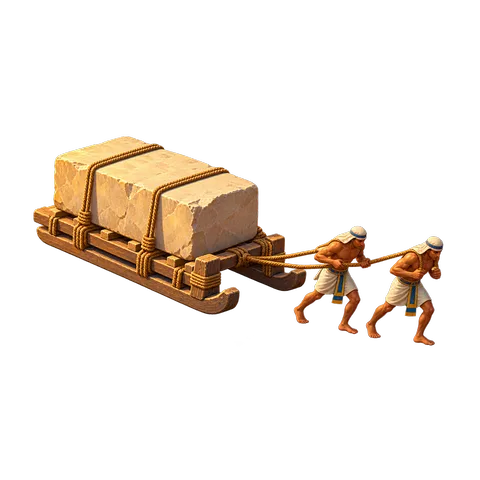
Oxen pulled plows after the flood, trod the harvested grain to separate it from the stalks, and dragged sledges loaded with stone. A farmer's oxen were among the most valuable things he owned.
History Counting the cattle
Cattle were counted for taxes. A wooden model from the tomb of the official Meketre, made around 1980 BC, shows herdsmen driving his cattle past a shady porch, where Meketre sits with his scribes, who write down every animal.
Art In this artwork
The illustration shows an ox pulling a wooden cart loaded with sacks of grain, with the driver sitting on top.
Look closer
- Count the sacks on the cart.
- Look at the wheels. How are they made?
Think about it
- Why might a river be better than a road for moving heavy loads?
- What jobs did oxen do before tractors?
- How are heavy goods moved near you?
Key words
- Ox
- A cow or bull trained to work (plural oxen).
- Threshing
- Separating grain from the stalks.
- Migrant
- A person who moves to live in another place.
Sources
The history on this page is a short summary based on these sources:
- Reliefs of Ramesses III at Medinet Habu, Thebes, about 1175 BC
- Egyptian Museum, Cairo, model of a cattle count from the tomb of Meketre, about 1980 BC
- Ian Shaw (editor), The Oxford History of Ancient Egypt (2000)
- Encyclopaedia Britannica, "Ancient Egypt"