History What it was
In a world without photographs or television, most people in the Roman Empire would never see their emperor in person. Statues, along with portraits on coins, showed everyone what the ruler looked like and what he stood for. They were placed in forums, temples, baths and theaters across the empire.
History Sending a message
Statues were carefully designed to send a message. The marble statue known as the Augustus of Primaporta shows the first emperor as a young, calm commander, with carvings on his armor celebrating a diplomatic victory. Many statues were originally painted in bright colors, though the paint has mostly worn away.
Bronze statues were sometimes covered in a thin layer of gold. Most ancient bronzes were later melted down for their metal. The bronze statue of the emperor Marcus Aurelius on horseback survived because, for centuries, people believed it showed Constantine, the first Christian emperor. The original is now in Rome's Capitoline Museums.
History Giant statues
Some statues were enormous. Pieces of a colossal statue of Constantine, including a head more than two meters tall and a giant hand, can be seen in the courtyard of the Capitoline Museums.
History Augustus and the birth of Jesus
Jesus was born during the reign of Augustus. The Gospel of Luke begins the story of his birth: "Now in those days a decree went out from Caesar Augustus that a census should be taken of the whole empire" (Luke 2:1). Jesus grew up in a land ruled by Rome and was sentenced by the Roman governor Pontius Pilate. In AD 313, Constantine, the first Christian emperor, allowed Christians across the empire to worship freely.
Art In this artwork
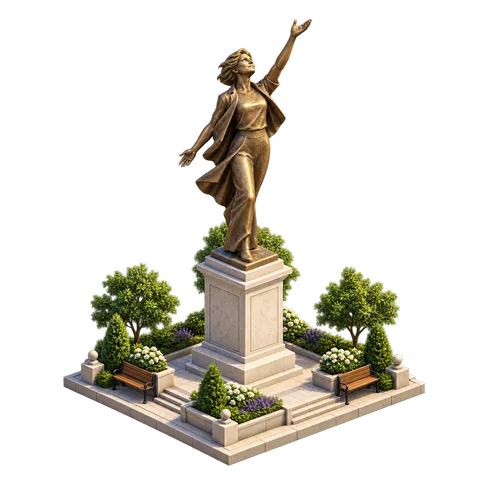
This golden statue is the artist's interpretation of an imperial statue on a decorated base.
Look closer
- Notice the pose: the raised arm and the armor.
- Why might the statue be golden?
Think about it
- How do leaders today make sure people know what they look like?
- Why would a statue show a ruler as young and strong?
- What happens to statues of leaders when opinions about them change?
Key words
- Portrait
- An image of a real person.
- Gilded
- Covered with a thin layer of gold.
- Propaganda
- Images or messages designed to shape what people think.
Sources
The history on this page is a short summary based on these sources:
- Smarthistory, "Augustus of Primaporta"
- UNESCO World Heritage Centre, "Historic Center of Rome"
- The Bible, Gospel of Luke
- Encyclopaedia Britannica, "Edict of Milan"