Imagined What it could do
Imagine a cottage built from what the forest floor offers: clay, straw, fallen timber and stone. When it is no longer needed, it could slowly return to the earth.
Real world Real natural building
- Cob: a mix of clay soil, sand and straw, built up in thick, sculpted walls. Some cob houses in England are hundreds of years old.
- Straw bale: bales of straw stacked like big bricks and plastered. They insulate very well. In the United States, the International Residential Code includes an appendix on straw bale construction.
- Rammed earth: damp soil packed hard into frames to make strong, striped walls.
- Timber and stone gathered locally, cutting transport.
These materials need little energy to make, can often be found near the building site, and contain few harmful chemicals.
Real world The secret: "good boots and a good hat"
Earth and straw buildings must be kept dry. Natural builders say a cottage needs "good boots", a stone or concrete base that lifts walls off damp ground, and "a good hat", a wide roof overhang that keeps rain off the walls. Breathable lime or clay plasters let any moisture escape.
Art In this artwork
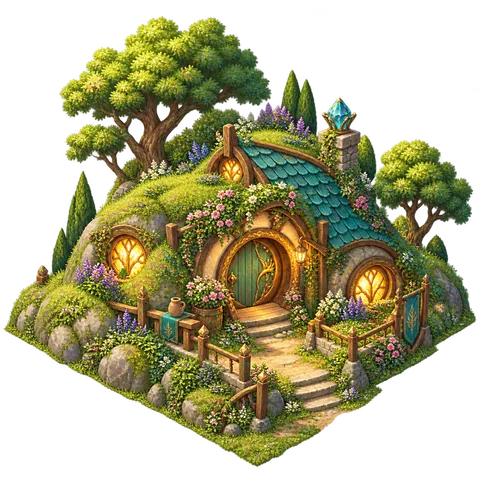
This illustration shows a small timber-framed cottage with a teal roof and a garden. Here we imagine it built from natural materials.
Look closer
- Find the roof overhang. How does it protect the walls?
- What could the walls be made of?
Think about it
- What materials could you find within a few kilometers of your home to build with?
- Why might natural materials be healthier to live with?
- What are the downsides of building with earth and straw?
Key words
- Cob
- A building mix of clay, sand and straw.
- Straw bale
- A tight block of straw used like a giant brick.
- Lime plaster
- A breathable plaster made from lime.
Sources
The real-world facts on this page are based on these sources:
- International Code Council, International Residential Code, Appendix on strawbale construction
- Janine Benyus, "Biomimicry: Innovation Inspired by Nature" (1997)